Skip to content

Disaster Preparedness

Great Oregon ShakeOut: Let’s Be More Ready Than Less

October 15, 2026 — Today’s Great Oregon ShakeOut is a chance to turn concern about earthquakes into something useful: practice. The coordinated drill is at 10:15 a.m. local time. If you miss that moment, choose another time to rehearse with your household or coworkers. Oregon’s official ShakeOut information explains how to participate.

Let’s be more ready than less. Practice helps make us safer. It helps us respond instead of react.

Practice Drop, Cover, and Hold On
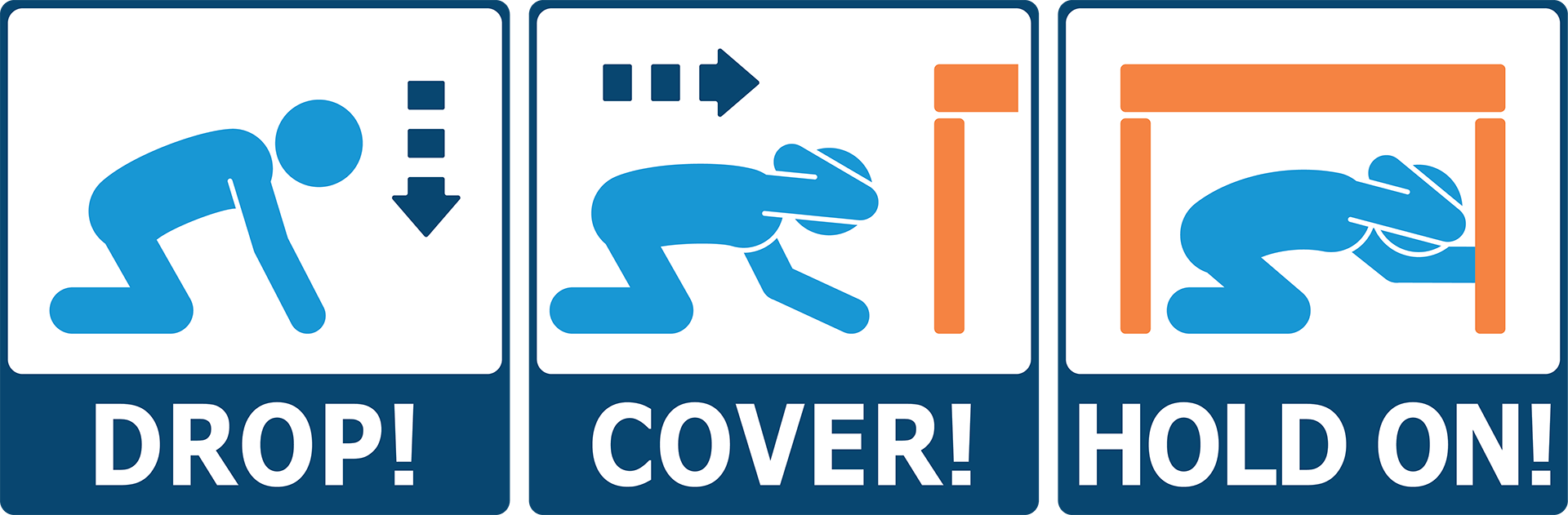
Three earthquake safety actions: drop to hands and knees, cover under a sturdy table, and hold on to it.
Earthquake safety graphic: Earthquake Country Alliance. Read the official instructions and adaptations.
  1. Drop onto your hands and knees where you are.
  2. Cover your head and neck. Get beneath a nearby sturdy desk or table if possible; otherwise protect yourself away from windows.
  3. Hold On to your shelter and be ready to move with it until shaking stops.

Adapt the drill to your abilities. If you use a wheelchair, lock the wheels if possible, cover your head and neck, and hold on. Do not attempt to get onto the floor if you cannot safely do so. Accessible safety guidance offers more options. Practice the actions you would use where you live, work or study.

We live in earthquake country

Off our coast, the Cascadia Subduction Zone can produce a magnitude 9 or greater earthquake and a destructive tsunami. Inland communities also face earthquake hazards. Preparedness is part of living here. Oregon Emergency Management’s earthquake guidance explains the risk and protective actions.

Near the ocean, protect yourself during shaking. After a large earthquake, once shaking stops, walk inland and to high ground without waiting for an official warning. Know your local evacuation route before you need it. The first action during shaking and the next action afterward are both worth practicing

During my years as Lincoln County’s public information officer, I saw how Japan’s March 2011 earthquake and tsunami and the dock that later washed ashore at Agate Beach made preparedness feel immediate. In my experience, those events prompted more conversations about our own risks, evacuation routes and whether our families were ready.

The dock came from Misawa, Japan. Torn loose in the 2011 disaster, it drifted across the Pacific before reaching the Newport area in June 2012. Its arrival was separate from the tsunami waves themselves. A preserved section became an educational exhibit and memorial at Hatfield Marine Science Center. OSU’s account tells that story.

There is a personal connection for me, too. Commissioner Terry Thompson was one of the commissioners I worked for. In 2013, he traveled to Misawa with OSU scientist John Chapman and Natural History Museum researcher Leslie Harris as they investigated organisms on replacement docks. The museum’s May 2013 research newsletter, page 7, documents their visit.

Terry has also endorsed me in this race, which makes that shared history especially meaningful to me. What stays with me here is the connection between public service, science and people helping coastal communities understand a shared risk.

Kathryn Schulz’s widely discussed 2015 New Yorker article, “The Really Big One,” brought further attention to Cascadia. Awareness can start the conversation. Practice gives us an action to take.

Well done Lincoln County

After the drill, talk about what you noticed. Is your cover spot accessible? Could something heavy fall nearby? Does everyone know where to meet and how to reconnect? Coastal households should review their evacuation routes together.

Use the Seven Steps to Earthquake Safety to build on the drill, from securing your space and planning communications to supplies and recovery. Oregon’s Be 2 Weeks Ready program provides household planning resources.

We don’t have to solve every preparedness problem in one day. We can practice, find a gap and do something about it.

Let’s be more ready than less.

Building a COAD

Over the past several months I have attended multiple Lincoln County COAD (Community Organizations Active in Disaster) meetings. These conversations have reminded me of my former role serving as Public Information Officer for both the Lincoln County Board of Commissioners Office and the Emergency Operations Center during major emergencies and disaster response efforts.

What is a COAD?

What I continue to see is an inspired effort to bring together local organizations, volunteers, nonprofits, faith-based partners, emergency management professionals, and community leaders to strengthen Lincoln County’s disaster preparedness and long-term resilience.

The former Long-Term Recovery Group (LTRG), originally created following the 2020 Echo Mountain Wildfire, is now transitioning into a broader countywide COAD model focused on helping Lincoln County prepare before disasters occur — not simply responding afterward.

I have been encouraged by the many individuals participating in this effort, including former Commissioner Kaety Jacobson, who is helping coordinate many aspects of the transition, along with representatives from Oregon State University Extension, Lincoln County Public Health, wildfire preparedness specialists, emergency response partners, and numerous community organizations.

Explore these links! Local Expertise at Work.

• Aaron Groth — Regional Fire Specialist with Oregon State University Extension
https://extension.oregonstate.edu/people/aaron-groth

• Dan Norton — Lincoln County Public Health
https://www.youtube.com/watch?v=g88ssbxOAB4

• Dustin Rymph — Oregon State Fire Marshal Office (OSFM), former Southwest Oregon Forest Protective Association program manager, and contributor to community wildfire and air quality resilience efforts
https://www.oakridgeair.org

Current efforts include planning around community sheltering, animal evacuation and sheltering, donations management, emergency communications, volunteer coordination, and long-term community resilience.

Sign up for Lincoln Alerts

As we enter wildfire season and continue facing risks from storms, flooding, earthquakes, power outages, and other emergencies, preparedness at every level matters.

Community preparedness starts at home. Residents should consider building emergency supply kits, developing family communication plans, preparing for evacuation scenarios, staying informed about local hazards, and checking on neighbors and vulnerable populations during emergencies.


Oregon Wildfire Risk Explorer

The Lincoln County COAD is actively seeking participation from volunteers, nonprofits, businesses, faith-based organizations, emergency response partners, and residents interested in preparedness and resilience. Strong local partnerships built before disasters occur can make a major difference when emergencies happen.

Preparedness is not just a government responsibility. It is a community responsibility — and building resilience starts long before disaster strikes.

Oregon Wildfire Readiness Guide


Help build our COAD!

Residents interested in becoming involved with Lincoln County COAD efforts, preparedness planning, volunteer coordination, or future training opportunities are encouraged to reach out to:

Allyson West
Lincoln County LTRG / COAD
[email protected]

Community members do not need to wait until a disaster occurs to become involved. One of the major goals of the Lincoln County COAD effort is building relationships, volunteer networks, communication systems, and preparedness capacity before emergencies happen.